
The Feline Veterinary Medical Association (FelineVMA) affirms that all interactions with cats — including but not limited to those occurring in veterinary settings, shelters, foster and boarding environments, grooming facilities, research institutions, and within private homes between cats and their caregivers — must prioritize feline physical health, emotional wellbeing, and species-specific behavioral needs.1-8
Evidence demonstrates that aversive handling techniques (e.g., heavy restraint, see Black Box Statement) negatively affect feline physiologic state, immune function, emotional health (e.g., fear-anxiety, see Figure 1), behavior, and long-term welfare.1–9 Conversely, Cat Friendly interactions and handling are based on an understanding of the feline species and improve patient compliance, recovery, human safety, healthcare, and preservation of the human–animal bond.1-7 A cat’s ability to have choice and a sense of control during interactions minimizes distress and protective behavioral responses.1-5 In cats, provision of hiding spaces and vertical space, predictable routines, and respectful interactions and handling significantly decrease protective behaviors and physiologic stress markers.1-3
Cooperative care, in which cats willingly participate in their care, improves compliance and minimizes protective behaviors in both the veterinary and home environments.1,3-5 Chemical restraint and not physical restraint should be used if needed to minimize feline protective emotions and behavioral responses and to protect human safety.
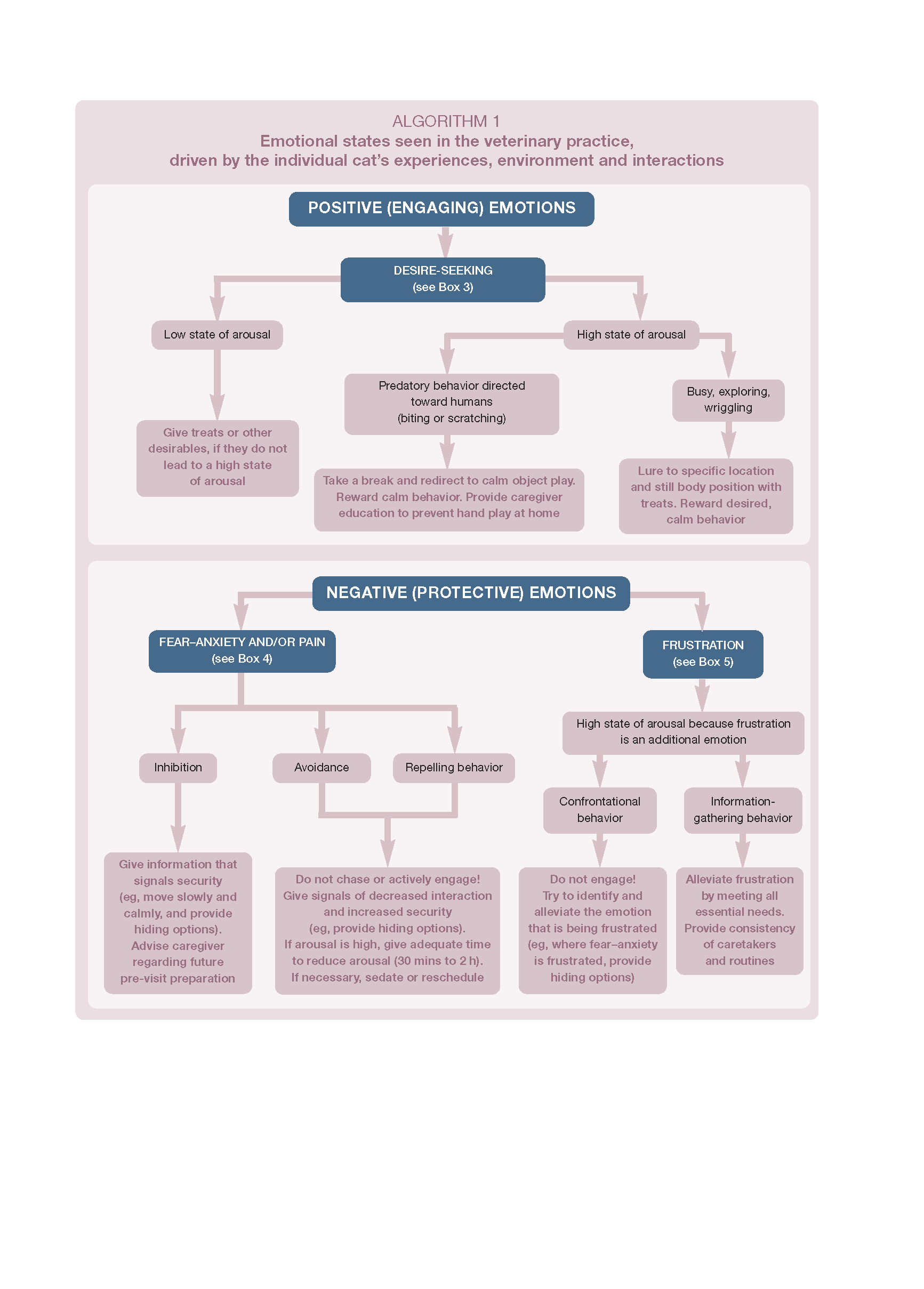
Every interaction with a cat — whether medical, routine, or social — has physiologic and behavioral impacts. While an adverse experience during a veterinary visit can lead to the cat becoming highly reactive at future visits,10-12 creating a positive experience may reduce stress of future visits, facilitating better veterinary care for cats.13 Promoting Cat Friendly interactions and handling, eliminating physical restraint, adopting precise and compassionate language, and prioritizing emotional wellbeing are essential to advancing feline welfare, preserving the human–animal bond, and improving long-term health outcomes. Veterinary professionals therefore have an ethical responsibility not only to implement Cat Friendly interactions and handling in clinical settings but also to educate caregivers regarding respectful interactions, including Cat Friendly medication administration at home.
Black Box Statement: Prohibited Handling Techniques
The FelineVMA explicitly states that scruffing, tight restraint, clipnosis, “boxing down,” or other physical restraint methods should NEVER be utilized in any setting. These methods cause fear-anxiety, pain, frustration, or learned helplessness and often result in human injury in the cat’s attempt to protect themself.
References
- Rodan I, Dowgray N, Carney HC, et al. 2022 AAFP/ISFM Cat Friendly Veterinary Interaction Guidelines: Approach and Handling Techniques. J Feline Med Surg. 2022 Nov;24(11):1093-1132.
- Taylor S, St Denis K, Collins S, et al. 2022 ISFM/AAFP Cat Friendly Veterinary Environment Guidelines. J Feline Med Surg. 2022 Nov;24(11):1133-1163.
- Heath S. Environment and Feline Health: At Home and in the Clinic. Vet Clin North Am Small Anim Pract. 2020 Jul;50(4):663-693.
- Moody CM, Picketts VA, Mason GJ, et al. Can you handle it? Validating negative responses to restraint in cats. Appl Anim Behav Sci 2018; 204: 94–100.
- Moody CM, Mason GJ, Dewey CE, et al. Getting a Grip: Cats Respond Negatively to Scruffing and Clips. Vet Rec. 2020 Mar 28;186(12):385.
- The Association of Shelter Veterinarians. The Guidelines for Standards of Care in Animal Shelters: Second Edition. JSMCAH. 2022;1(S1):1-76.
- Eigner DR, Breitreiter K, Carmack T, et al. 2023 AAFP/IAAHPC Feline Hospice and Palliative Care Guidelines. J Feline Med Surg. 2023 Sep;25(9):1098612X231201683.
- Stella J, Lord LK, Buffington CAT. Environmental factors that increase the risk of stress in cats. J Am Vet Med Assoc. 2011;238(10):1303–1313.
- Dawson LC, Dewey CE, Stone EA, et al. A Survey of Animal Welfare Experts and Practicing Veterinarians to Identify and Explore Key Factors Thought to Influence Canine and Feline Welfare in relation to Veterinary Care. Anim Welf 2016; 25: 125–134.
- Takagi S, Tsuzuki M, Chijiiwa H, et al. Use of Incidentally Encoded Memory from a Single Experience in Cats. Behav Processes 2017; 141: 267–272.13
- Fiset S and Doré FY. Duration of Cats’ (Felis catus) Working Memory for Disappearing Objects. Anim Cogn 2006 Jan;9(1):62-70.
- Vitale Shreve KR and Udell MAR. What’s Inside Your Cat’s Head? A Review of Cat (Felis silvestris catus) Cognition Research Past, Present and Future. Anim Cogn. 2015 Nov;18:1195–1206.
- Nibblet BM, Ketzis JK, Grigg EK, et al. Comparison of Stress Exhibited by Cats Examined in A Clinic Versus A Home Setting. Appl Anim Behav Sci 2015; 173:68-75.
Additional Reading
2022 AAFP/ISFM Cat Friendly Veterinary Interaction Guidelines: Approach and Handling Techniques: catvets.com/interaction.
As well as the new Cat Friendly Handouts as part of the Cat Friendly campaign, which expand in much greater, yet succinct, detail on the components in this statement: catvets.com/CatFriendly.
This Position Statement updates and replaces: 2019 Respectful handling of cats to prevent fear and pain
Download Position Statement© Feline Veterinary Medical Association, 2026