

Cat Friendly is more than a program or designation
It is an evidence-based approach to feline care that helps veterinary teams better understand cats’ unique behavioral, emotional, and medical needs while creating a more positive experience throughout the veterinary journey.
The result is better healthcare for cats, improved experiences for caregivers, greater confidence for veterinary teams, and stronger outcomes for practices.

For Cats
Cats benefit from a veterinary experience designed around their behavioral, emotional, and medical needs. Cat Friendly standards can:
- Reduce fear-anxiety, and distress associated with veterinary visits1, 2, 4
- Support more thorough physical examinations5
- Improve diagnostic opportunities, patient assessment, and outcomes2, 3, 5
- Increase detection of common feline diseases1, 5
- Encourage more consistent preventive care throughout life1
- Create safer, more positive healthcare experiences that make future visits easier1,4,6

For Caregivers
Many caregivers delay or avoid veterinary visits because they believe the experience is stressful for their cat or difficult to manage. When caregivers feel supported and their cats have a better experience, they are more likely to seek care proactively rather than waiting until a problem becomes severe. Cat Friendly standards help:

For Veterinary Professionals
Working with cats should not feel unpredictable, stressful, or unsafe. Cat Friendly techniques help veterinary professionals:
- Better understand feline emotions, behavior, and wellfare needs4
- Increase confidence when working with feline patients4
- Improve patient cooperation, care and outcomes1
- Improve team efficiency and workflow1, 2
- Reduce the risk of workplace injuries associated with feline handling1, 6, 7
- Improved communication skills for discussing feline care with caregivers1

For Practices
Cat Friendly isn’t simply about creating a better experience. It’s also good medicine and good business. Benefits may include:
- Increased utilization of feline healthcare services5, 7
- Stronger client retention and loyalty4, 7
- More complete examinations and diagnostics2, 5
- Earlier disease detection and treatment1
- Improved team dynamics4
- Safer teams; reduced workers compensation claims6, 7
- Increased opportunities for preventive care and lifelong patient relationships1
- Increased practice revenue4, 5, 7
As cat ownership continues to grow, practices that embrace feline-focused care are positioned to better meet the needs of a rapidly expanding population of cats and caregivers.
Cats play an increasingly important role in companion animal healthcare
Cats now represent a growing share of the pet population, and recent data show that feline veterinary visits are increasing even as canine visits have declined.
At the same time, many cats continue to receive less routine and preventive care than they need, creating a significant opportunity for veterinary medicine. The veterinary profession has an opportunity to close that gap and ensure cats receive the same consistent, proactive care expected for other companion animals.
CATalyst Council Veterinary Visit Forecast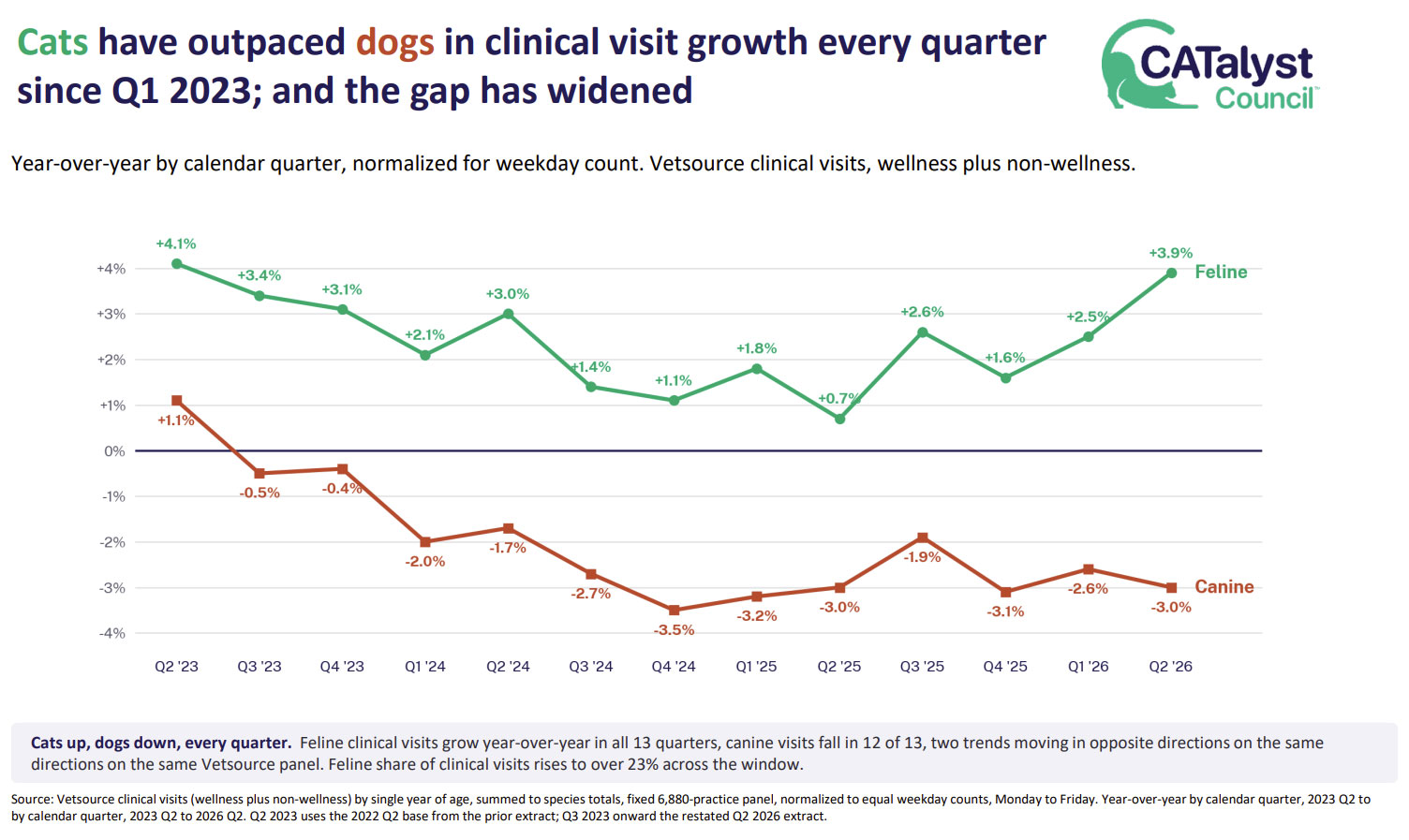
Ayers J, Fortunato G, Wuhrman K, Brunt J, Hansbauer J, Crisp S, et al. Puppocalypse, Kitten Craze, and the Expectations Reset. CATalyst Council; 2026 Aug.
The challenge is not a lack of knowledge or medical advances.
Over the last decade, research has demonstrated that feline-specific approaches to handling, communication, environment, and care can improve the veterinary experience for cats, caregivers, and veterinary teams alike. Yet many practices still face barriers to implementation, and many caregivers continue to delay or avoid veterinary visits because they perceive them as stressful for their cat.
The good news is that meaningful progress does not require a complete practice transformation.
Small, practical changes, such as modifying handling techniques, reducing environmental stressors, using accurate terminology, and providing better pre-visit preparation, can have a measurable impact on visit quality, team confidence, diagnostic opportunities, and overall patient outcomes. This moment represents an important opportunity to make feline healthcare more effective, accessible, and successful for everyone involved.
- Rodan I, Dowgray N, Carney HC, Carozza E, Ellis SLH, Heath S, Niel L, St Denis K, Taylor S. 2022 AAFP/ISFM Cat Friendly Veterinary Interaction Guidelines: Approach and Handling Techniques. J Feline Med Surg. 2022. doi:10.1177/1098612X221128760.
- Moody CM, Picketts VA, Mason GJ, et al. Can you handle it? Validating negative responses to restraint in cats. Appl Anim Behav Sci. 2018;204:94-100. doi:10.1016/j.applanim.2018.04.012.
- Furgala NM, Moody CM, Flint HE, et al. Veterinary background noise elicits fear responses in cats while freely moving in a confined space and during an examination. Behav Process. 2022;201:104712. doi:10.1016/j.beproc.2022.104712.
- Feline Veterinary Medical Association. Cat Friendly Practice® Program: 2025 survey results infographic [Internet]. 2025 [cited 2026 Sep 17]. Available from: https://catvets.com/cat-friendly/cfp/
- St Denis K, Saffire A, Michael H, Drake C, Burton W. Cat Friendly Practice improves feline visits, resulting in increased laboratory testing and increased diagnosis of certain common feline conditions. J Feline Med Surg. 2023;25(11). doi:10.1177/1098612X231204199.
- Cat Friendly Practice Program reduces the risk of injury. Journal of Feline Medicine and Surgery. 2022;24(7):676. doi:10.1177/1098612X221106357.
- 10 years of Cat Friendly. J Feline Med Surg. 2022;24(7):675. doi:10.1177/1098612X221106356.
Looking for More?
Continue your Cat Friendly journey with:
Cat Friendly Practice® Designation for practices committed to feline-centered care
Cat Friendly Certificates for individual veterinary professionals