
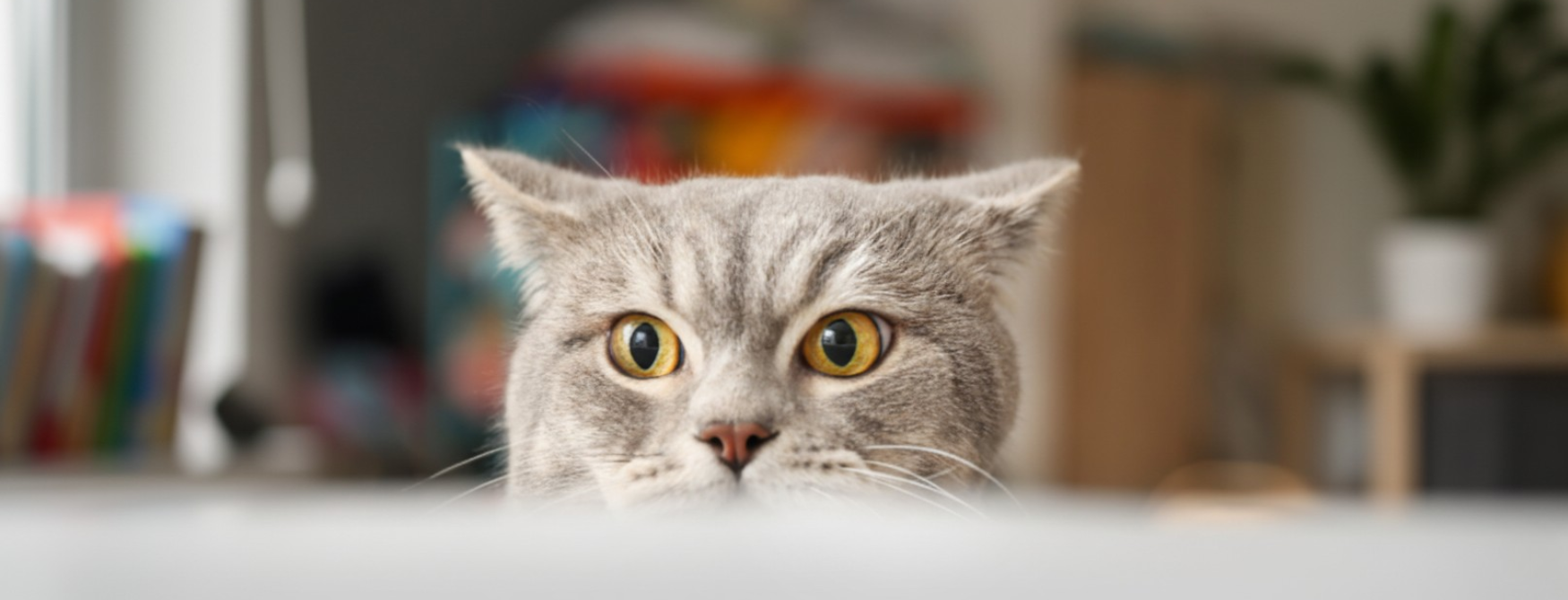
While it is easier to prevent undesirable behaviors than to manage them (see Techniques to Prevent Unwanted Behaviors), positive reinforcement training can still help reverse these behaviors.
Disciplining Can Have Negative Effects
- Disciplining in the form of verbal or physical punishment (e.g., using squirt bottles) in an attempt to stop unwanted behaviors can increase feline protective emotions, lead to additional undesirable behaviors, and potentially break down the human-cat relationship.
- The protective emotions also make it more difficult for the cat to learn new behaviors.
- Since many behaviors perceived as undesirable to the caregiver are normal cat behaviors or inadvertently rewarded, a change in human behavior is often needed. For example, if a cat is scratching a sofa, using a furniture protector for the sofa and placing a tall, sturdy scratching post or cat tree in that location will allow the cat to engage in normal scratching behavior on an item that caregivers prefer to be scratched. The cat is then rewarded for scratching on the desired surface, and the caregiver can implement positive reinforcement techniques.
Use of Synthetic Feline Pheromones
-
Cats performing undesirable behaviors often have distress (decreased coping ability) and may benefit from the addition of synthetic feline pheromones in order to set cats up for success.
Frequently Observed Behaviors in the Home
Waking Caregivers Early
Reasons for the Behavior
- A caregiver may get out of bed and feed their cat, but go back to sleep until their alarm rings. However, this human behavior of feeding the cat teaches the cat to continue to wake them early for food since the cat is inadvertently rewarded for this behavior by getting the food when they want it.
Solutions
- As cats are hunters and foragers, it’s best to take the human out of the feeding equation.
- Use a timed, automated feeder or treat dispenser that can toss one dry kibble at a time in different directions and that opens just before the cat would normally wake the caregiver.
- The timed, automated treat dispenser simulates normal hunting and feeding behaviors, which is very rewarding for the cat and will keep them busy, allowing caregivers to get their desired sleep.
Vocalizing Frequently for Attention
Reasons for the Behavior
- This behavior most commonly occurs because the individual cat’s needs have not been met, especially Pillars 3 (provide opportunity for play and predatory behavior) and 4 (provide positive, consistent and predictable human–cat social interaction) (see 2013 AAFP/ISFM Environmental Needs Guidelines and 2024 AAFP Intercat Tension Guidelines: Recognition, Prevention, and Management for the Five Pillars of a Feline Healthy Environment). Some diseases can cause increased vocalization (e.g., hyperthyroidism, hypertension, pain, sensory loss [e.g., hearing loss], cognitive dysfunction). Seek medical attention if vocalization increases, or if this is a new behavior.
Solutions
- In addition to meeting the individual cat’s needs, it is important to ensure positive and predictable human-cat interactions at consistent times daily to help mitigate this attention-seeking behavior.
- This approach does not need to be based on specific times, but rather a routine schedule when caregivers typically have more time.
- For example, cats need interactive play at least twice daily, and this, and other positive human-cat interactions, can be scheduled before and after work, or in the evening and before bedtime
- Rewarding calm and quiet behaviors with preferred treats and attention is an effective way to teach a cat a new, desirable behavior to replace the undesirable behavior.
- If the cat vocalizes at specific times, redirect their behavior before it starts, offering an alternative activity to prevent vocalization (see example above for “Waking Caregivers Early”).
Getting on the Counter
Reasons for the Behavior
- Perhaps a caregiver has given their cat bits of human food either while on or from the counter (e.g., tossing a treat from the counter to the floor, hoping to entice them down), but these human behaviors inadvertently reward the cat’s behavior.
- Cats may also get onto the counter so they can be close to the person.
- As solitary hunters and scavengers, cats find counters rewarding because they have learned they can obtain food there.
- Even if a caregiver yells, squirts water, or uses a deterrent such as a scat mat (which will likely cause fear-anxiety and additional undesirable behaviors), the cat will continue to jump onto the counter because the food reward outweighs the aversive experience.
Solutions
- The most effective strategy is to replace punishment with positive reinforcement of desirable behaviors.
- Never leave human food on the counter or other accessible surfaces.
- Instead, provide high, desirable perches at a level the cat can see the person working in the kitchen, but not jump from the perch to the counter. Provide at least one warm option as cats usually prefer warmth, such as a sunny window or a safely heated commercial cat bed or mat (not a heating pad, which can cause burns). Use treats to reinforce the cat’s use of the perch.
- You can also train the cat with luring and capturing, rewarding them whenever they choose the perch instead of the counter.
Biting
Play Biting
- Caregivers often think it’s cute to move their hands and feet for kittens to nip at. This human behavior teaches the cat that play biting is acceptable, but this learned play behavior may continue when cats are adults, causing pain and possible injury.
Solutions
- It is recommended to replace hand play with play sessions using a toy on a wand or another object (i.e., toys that can be tossed down a hall to elicit chasing), a minimum of twice daily to satisfy the cat’s hunting instincts and to keep hands out of reach.
- If a cat still tries to nip at feet as people walk through the home, recommend redirecting the “hunting” to a toy by carrying a dangling wand toy when walking through the home for the cat to learn the appropriate behavior.
- Educate caregivers that object play should continue routinely a minimum of twice daily, regardless of the cat’s age, as this simulates hunting behavior, satisfying an important feline environmental need. These sessions can be short bursts of a few minutes to mimic hunting.
Biting with Petting
Even if a cat wants to be petted and enjoys it for a while, if petted in an undesirable location or too long, too quickly, or too vigorously, they may then turn and bite with the goal of stopping the overpetting.
Solutions
- Cats prefer petting over the facial glands instead of other body parts, with the caregiver positioned to the side of them instead of in front (see Pillar 4 of the 2013 AAFP/ISFM Environmental Needs Guidelines and the 2022 AAFP/ISFM Cat Friendly Veterinary Interaction Guidelines: Approach and Handling Techniques).
- For cats who bite with petting, the safest facial glands to pet over initially are the temporal glands (between the ears and eyes) because they are furthest from the mouth. Educate caregivers to both position themselves and pet from the side.
- Educate caregivers about how cats prefer short and frequent interactions rather than long ones, with slow petting, pausing periodically to see if the cat wants more, which prevents frustration (see video – How to Interact with Your Cat | The Battersea Way).
- Petting the belly is generally not appropriate and can lead to people being bitten. Cats may expose their belly as a calm and relaxed greeting behavior, but the cat is not asking to be petted there.
Biting with Intense Frustration
Reasons for this Behavior
- This usually occurs when a cat sees an outdoor cat, or if there is physical conflict between household cats, and the caregiver tries to intervene or comfort a cat.
- The cat is highly frustrated and aroused as they cannot reach the cat outdoors, or the household conflict was abruptly stopped, and they redirect their bite onto the person.
- This is a normal response to the frustration, not a bad behavior, even though it is dangerous. The cat does not want to bite the person, but is still aroused and feeling unsafe, and unintentionally biting the person.
Solutions
- Caregiver behavior should be redirected to never approach or pick up a highly aroused cat, but rather to intervene with a visual barrier.
- Good examples are placing a large piece of cardboard or opaque (not clear) plastic between household cats or a privacy film on windows or patio doors where outdoor cats come to the home (see 2024 AAFP Intercat Tension Guidelines: Recognition, Prevention, and Management for more information on protecting human safety, and managing intercat tension between household cats or an outdoor cat frustrating an indoor cat).
House-soiling or Marking
First: Determine if There Is a Medical Cause
- As underlying medical problems are common, a thorough history, examination with orthopedic assessment, and diagnostics should be performed. In addition to obtaining a baseline dependent on the cat’s life stage (see 2021 AAHA/AAFP Feline Life Stage Guidelines), the following is indicated:
- If urine soiling is occurring, a urinary ultrasound, urine culture, and other diagnostics as needed are required (the urinalysis is included in the baseline). These diagnostics are necessary to rule out uroliths and other bladder abnormalities, and to identify stress-related feline idiopathic cystitis, also known as bladder pain syndrome (see 2014 AAFP/ISFM Guidelines for Diagnosing and Solving House-soiling Behavior in Cats), or diarrhea or constipation and their etiologies
- If it is fecal soiling, the assessment of fecal consistency, checking for parasites, and other diagnostics as needed are required
Next: Are Environmental Needs Being Met?
- If medical conditions are ruled out, the cause is feline distress within the cat’s physical and/or social environment.
- Instead of punishment or the use of aversives, which can increase a cat’s distress and worsen undesirable behaviors, it is best to address the cat’s environmental needs.
- This includes using the optimal litter and placing litter boxes in appropriate locations for each cat, cleaning soiled areas with recommended enzyme breakdown products (see 2014 AAFP/ISFM Guidelines for Diagnosing and Solving House-soiling Behavior in Cats and the AAFP House-Soiling Guideline Brief), and minimizing the individual’s stressors.
- Ensure that litter boxes are placed in different locations in the home, with at least one box per floor to allow easy exit and entry, and to minimize potential blocking access to boxes by another cat or other species (see 2024 AAFP Intercat Tension Guidelines: Recognition, Prevention, and Management for more information about intercat tension and blocking behavior).
If the house-soiling is secondary to feline idiopathic cystitis, manage the condition both medically and by modifying the physical and social environment to minimize all stressors within the home. Additional diagnostics and management are indicated if there are recurrences. A referral to a board-certified veterinary behaviorist, a PhD in animal behavior, or a veterinarian with additional training in feline behavior is indicated if meeting the environmental needs is insufficient to resolve the problem.
Undesirable Scratching
Scratching is a normal cat behavior that serves multiple functions, including marking their territory and maintaining nail health. Cats prefer to scratch or mark in prominent areas, which may lead to furniture or carpet scratching. This often occurs when they wake up or are near windows and doors. Increased scratching behavior is a sign of distress. Punishment will increase undesirable scratching and must be avoided. The FelineVMA strongly opposes declawing, which can lead to both acute and chronic pain and undesirable behavior changes.
Solutions
- Most cats prefer vertical scratching surfaces; others prefer horizontal surfaces. A caregiver may provide several options to learn what an individual cat prefers. A cat’s preference may change as they get older; for example, a senior cat is likely to change their preference from vertical to horizontal surfaces.
- Use treats, toys, or preferred human attention to entice and reward the cat’s use of scratching posts or other scratchers through positive reinforcement training.
- Resolve the undesirable behavior by recommending the caregiver provide sturdy and tall scratching posts or cat trees with sisal rope or other preferred scratching materials in the location(s) they are scratching.
- Additionally, if the cat has already learned to scratch the sofa or carpet, apply a carpet or furniture protector, such as plastic commercial sofa protectors adhered onto the sofa (do not use double-sided sticky tape as a deterrent, as punishment must be avoided).
- Covering the area with a throw blanket(s) may also be used to aid in protecting furniture.
- Cats like to scratch when they wake up, so keeping an appropriate scratching surface near the cat’s preferred resting spot is helpful.
- See the Claw Friendly Educational Toolkit for additional detailed information.
Recommend a Medical Assessment if a Cat is:
- Showing any changes in their usual behavior(s).
- Demonstrating increased vocalization.
- Biting or scratching people.
- Urinating or defecating outside the litter box (soiling or marking).
- Exhibiting chronic anxiety or compulsive behaviors.
Client Handout
Key Takeaways
- No Disciplining: Avoid reprimanding or physical discipline to punish behavior.
- Meet Needs: Ensure the cat’s environmental needs are met to allow for normal, instinctual behaviors in preferred locations.
- Redirect and Reinforce: Redirect and positively reinforce desired behaviors.
- Change Habits: Adjust your own habits if you are inadvertently rewarding undesirable behaviors.
- Have Patience: Remember that changing unwanted behaviors takes time and consistency.